

Earlier in this series, I covered:
A RAG system can produce a fluent answer even when retrieval supplied incomplete or poorly ranked evidence. Evaluating only the final answer can therefore hide what happened earlier in the pipeline.
Retrieval metrics isolate that earlier stage. They compare the passages returned for a question with passages previously labeled relevant. Precision, recall, and mean reciprocal rank examine different properties of that comparison.
Metrics begin with relevance labels
Before calculating a retrieval metric, an evaluation needs questions and relevance judgments. A relevance judgment records whether a particular passage is considered relevant to a particular question under the evaluation’s stated criteria.
These labels are independent of the retriever’s own scores. A passage does not become relevant merely because a vector search placed it nearby or a reranker gave it a high value. The metric compares the system’s ranking with the prior judgments.
That means every number depends on the labeled set. If a useful passage was never judged, the evaluation may count it as non-relevant or leave it outside the calculation. If a label is wrong, the metric faithfully measures against the wrong label.
For a simple explanation, this article uses binary labels: relevant or not relevant. Some evaluations use graded relevance, but those require other metrics and conventions.
Precision and recall ask different questions
Precision@k looks only at the first k retrieved results. It divides the number of relevant passages in those results by k. In plain language, it asks: how much of the returned set was relevant?
Recall@k uses the same numerator but a different denominator. It divides the relevant passages found in the first k results by the total number of passages known to be relevant for that question. It asks: how much of the known relevant set did retrieval find?
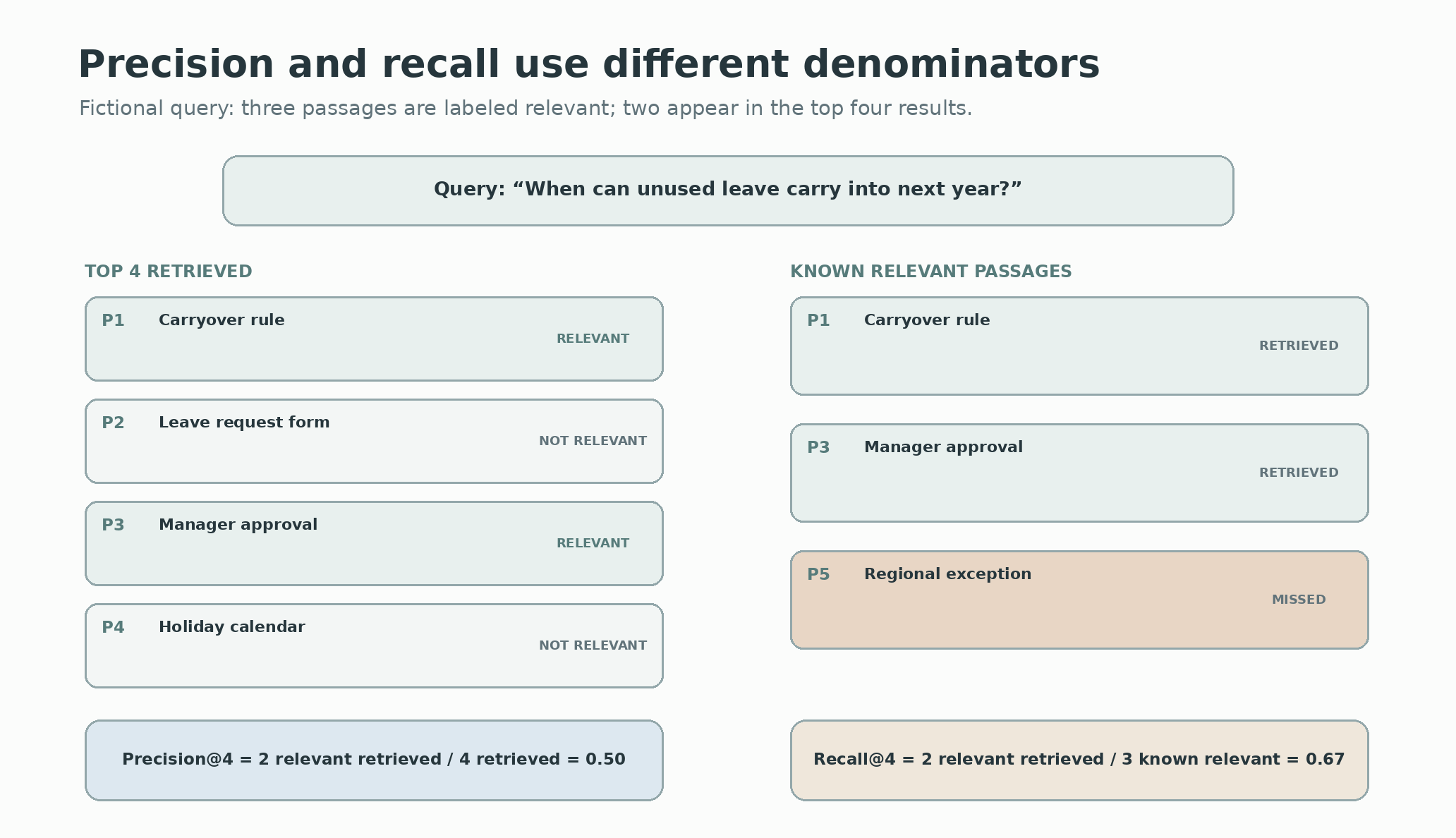
Consider a fictional leave-policy query with three passages labeled relevant. The system returns four passages, and two of them are relevant.
Precision@4 is 2 divided by 4, or 0.50. Recall@4 is 2 divided by 3, or approximately 0.67. The results are identical in both calculations; only the denominator changes.
The “@4” matters. It states the cutoff used to inspect the ranking. Precision@5 and Recall@5 would examine one additional result and could produce different values.
Mean reciprocal rank focuses on the first relevant result
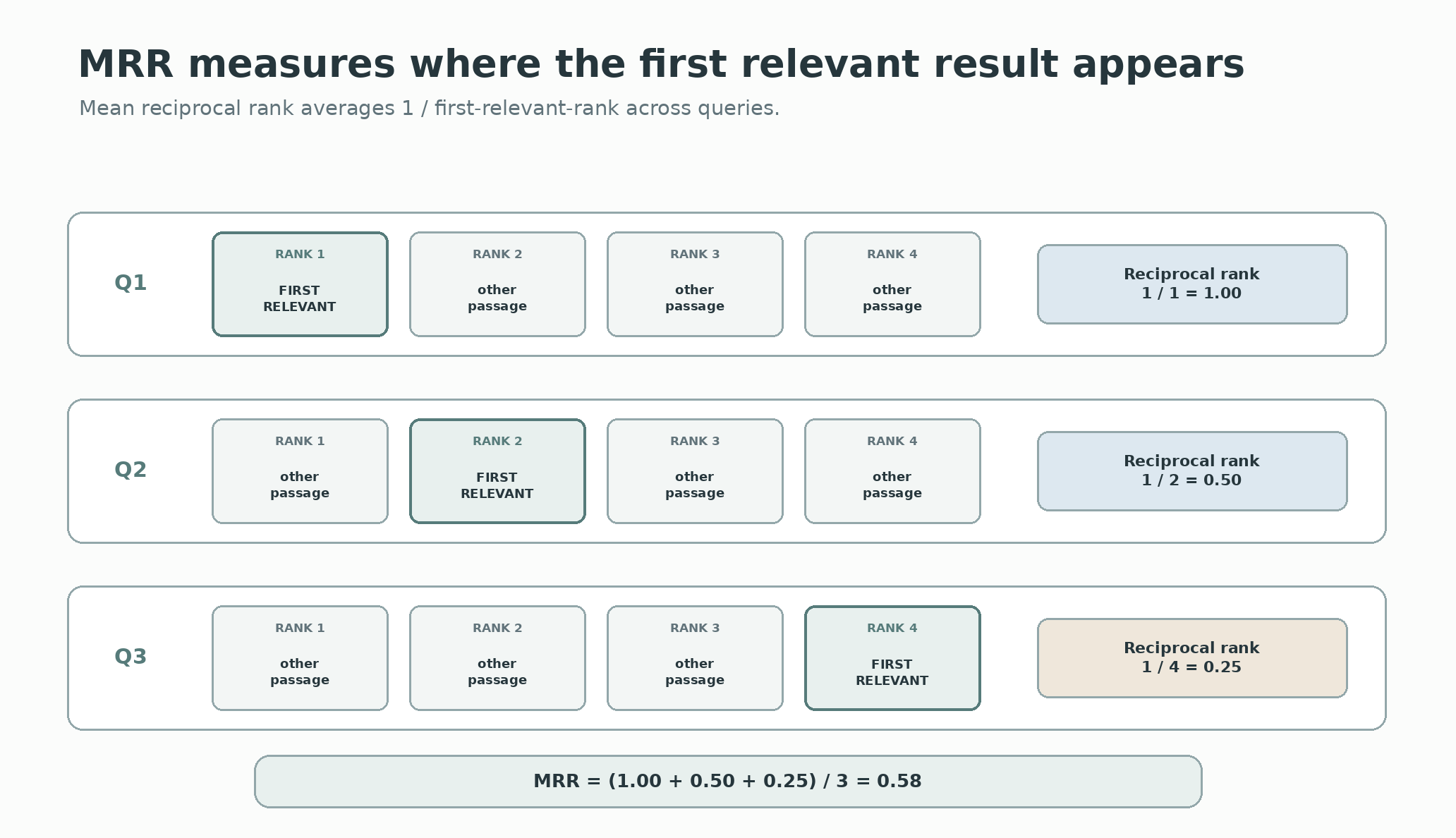
Reciprocal rank starts with the position of the first relevant result for one query. If the first relevant passage is ranked first, the reciprocal rank is 1 divided by 1, or 1. If it is ranked second, the value is 1 divided by 2, or 0.50. If it is ranked fourth, the value is 0.25.
Mean reciprocal rank, usually abbreviated MRR, averages those reciprocal ranks across a set of queries.
Suppose three fictional queries have their first relevant results at ranks 1, 2, and 4. Their reciprocal ranks are 1.00, 0.50, and 0.25. The mean is approximately 0.58.
If no relevant result appears within the evaluated ranking, that query normally contributes zero. When a cutoff is used, such as MRR@10, results below that cutoff do not count.
MRR does not consider where a second or third relevant passage appears after the first. It is therefore sensitive to early success but does not describe full coverage.
What the metrics do—and do not—measure
Precision, recall, and MRR are not interchangeable summaries.
Precision@k describes the concentration of relevant passages near the top of a returned list. Recall@k describes how much of the labeled relevant set appeared within that cutoff. MRR describes the rank of the first relevant result across queries.
A system can therefore have a strong MRR because it usually places one useful passage early while still missing other relevant passages. Another system may retrieve more of the known relevant set but mix those passages with more non-relevant results.
These observations do not identify a universally best metric. The useful metric depends on what the evaluation is intended to observe and how relevance was labeled. Reporting the metric name without its cutoff, query set, and relevance judgments leaves important context missing.
A passage can be relevant to a question yet still be outdated, internally incorrect, or insufficient by itself. Precision, recall, and MRR do not validate the source.
They also do not measure whether the language model used the passage faithfully. A retrieval run can score well while generation ignores the evidence, combines passages incorrectly, or produces an unsupported claim.
The labels themselves impose another limit. Relevance judgments may be incomplete, and two passages may contain the same underlying fact. Counting chunks, documents, and duplicate evidence can lead to different interpretations unless the evaluation defines the unit clearly.
Finally, metric values should be compared only when their setup is compatible. The same metric name can hide different cutoffs, corpora, query sets, labeling rules, or averaging choices.
Retrieval metrics are stage-specific evidence. They help diagnose what the retriever returned and where relevant passages appeared. They do not replace answer evaluation, citation checking, latency measurement, or review of the source collection.
Retrieval evaluation begins with questions and relevance judgments. The system returns a ranked list, and the metrics compare that list with the labeled relevant passages.
Precision@k measures the relevant share of the first k results. Recall@k measures the share of the known relevant set found within those results. MRR averages the reciprocal rank of the first relevant result across queries.
Each metric observes one part of retrieval behavior. None establishes that the source is correct or that the generated answer follows it.
The next explainer will cover how citations work in RAG: how passage identifiers and source metadata become links or references, and why the presence of a citation does not by itself prove claim-level support.