

Earlier in this series: “How RAG Works: From Document Indexing to Generated Answers,” “Why RAG Systems Split Documents into Chunks,” “How Embeddings and Similarity Search Work in RAG,” and “How Dense, Sparse, and Hybrid Retrieval Work in RAG.”
A retrieval method can rank passages by lexical or semantic relevance and still return material from the wrong product, language, date range, workspace, or permission boundary. Metadata filters handle that separate problem.
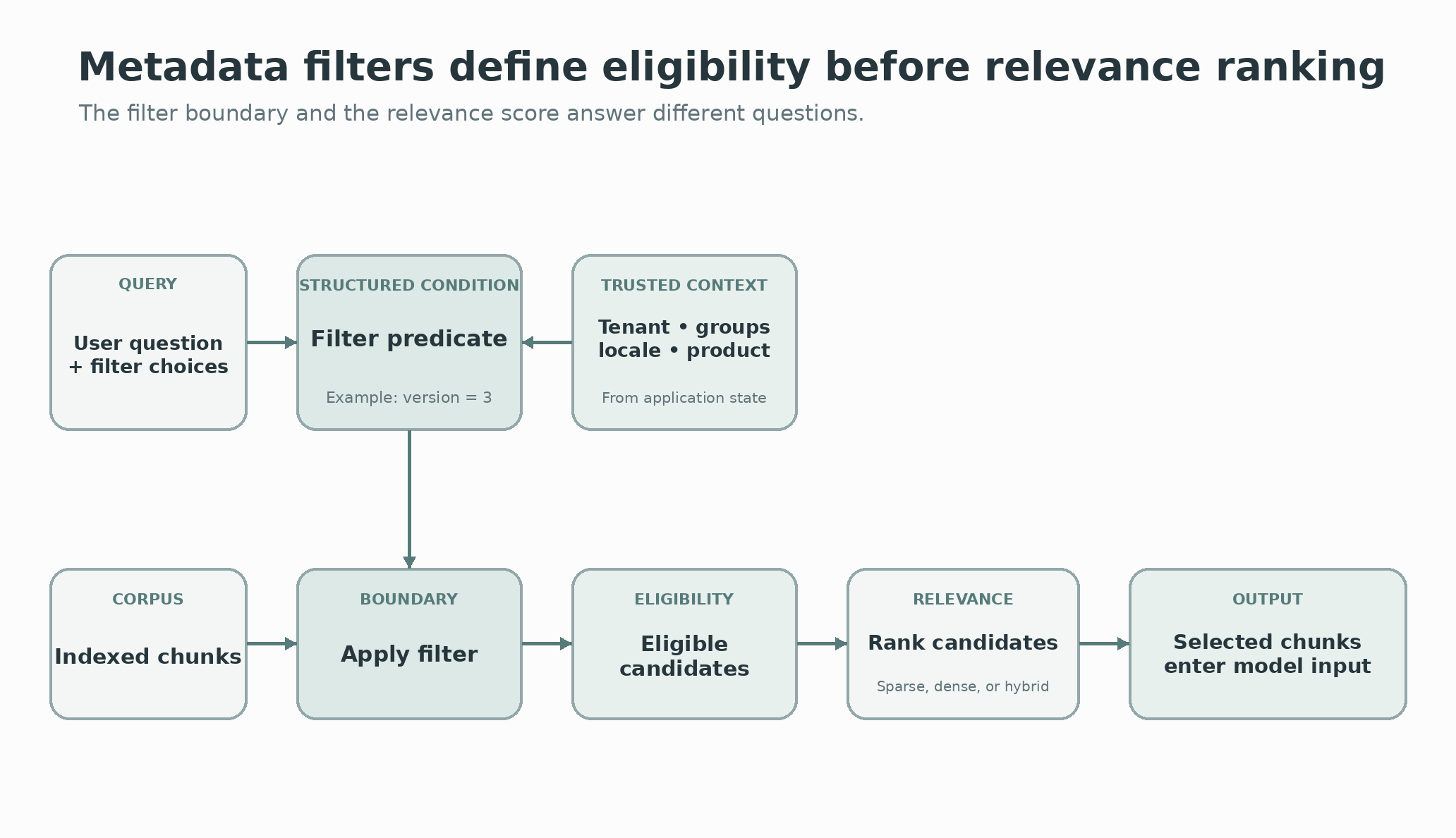
A filter is a structured condition attached to retrieval. It may restrict candidates by fields such as source, version, locale, document type, tenant, or access label. The important distinction is simple: a filter determines eligibility; a retrieval score determines ordering among eligible candidates.
Metadata filters define eligibility
Metadata is structured information stored alongside a document or chunk. A chunk of product documentation might carry fields such as product = Atlas, version = 3, language = en, source = handbook, and updated_at = 2026-08-14. These fields describe the chunk; they are not the chunk’s semantic representation.
At query time, a filter turns one or more fields into a predicate: product must equal Atlas, version must equal 3, and language must equal en. Chunks that do not satisfy the predicate are excluded from the relevant stage of retrieval.
This is different from adding words such as “Atlas version 3” to the query. Those words become relevance signals and may influence ranking. A structured filter establishes a condition that candidates must satisfy. It can therefore express constraints that should not be left to similarity alone.
Filter values need a trustworthy source
Some filters come from explicit user controls. A reader may choose a language, product, or date range in the interface. Others come from application state, such as the active workspace, authenticated tenant, or permissions associated with the signed-in user. A system may also extract a non-security filter from the query—for example, interpreting “the 2025 policy” as a year constraint—but that interpretation is fallible.
The source matters most for access control. A language model should not decide which private material a user may retrieve, and a prompt should not be treated as proof of authorization. Permission filters should be built from an authoritative identity and policy layer, then enforced by the application or search system before restricted text is passed to the model.
This does not make the retrieval result correct. It establishes a boundary around what the retrieval process is allowed to consider.
Prefiltering and postfiltering change the candidate flow
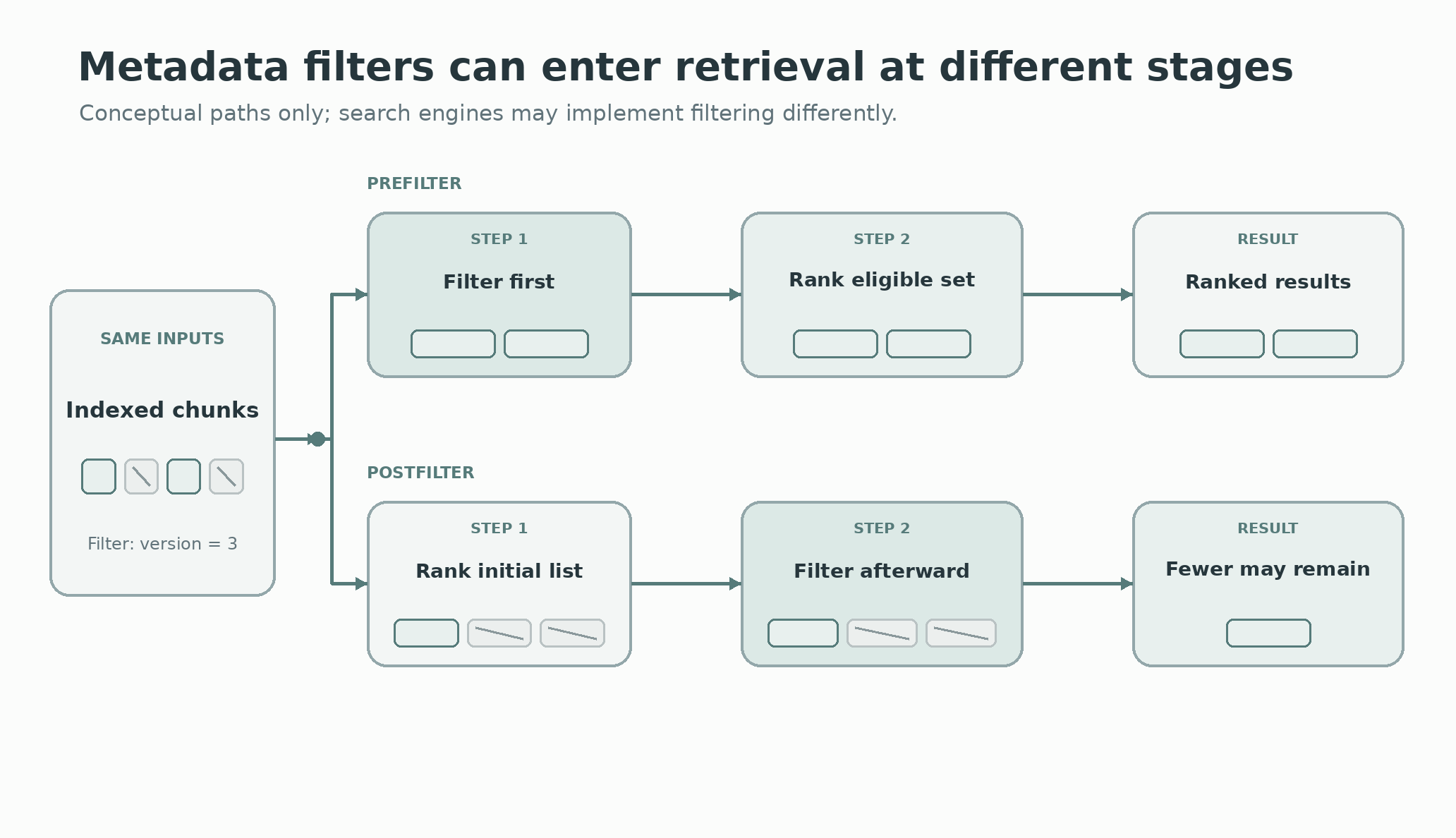
The words prefilter and postfilter describe when a structured condition is applied relative to candidate retrieval.
In a prefiltering flow, the condition constrains the search space before or during candidate selection. The retrieval method looks for the best matches among chunks that satisfy the filter.
In a postfiltering flow, the retrieval method first produces an initial candidate list, and the condition is applied afterward. If several highly ranked candidates fail the condition, the final list may contain fewer items than requested even when matching chunks exist elsewhere in the index.
Real search engines implement these operations in different ways. Some apply a filter during approximate-nearest-neighbor traversal; some filter a retrieved set; some select a strategy based on the query and index. “Before” and “after” are therefore useful mental models, not a universal description of every internal algorithm.
The placement changes the set that can reach the next stage. It does not change the filter into a relevance score, and it does not make the remaining passages sufficient for the user’s question.
Two examples of metadata filtering
Consider a documentation assistant for a fictional product named Atlas. The user asks, “How do I rotate an API token?” The index contains instructions for Atlas versions 2 and 3 in several languages.
A semantic or lexical search may rank an older version highly because its wording closely matches the question. The application can add product = Atlas, version = 3, and language = en as structured conditions. Retrieval then works within, or is later restricted to, that subset. The filter prevents known mismatches from reaching the answer context, but it does not prove that the selected version 3 passage is complete or current.
Now consider a fictional internal assistant serving several workspaces. Each chunk carries tenant and access-group metadata. When a signed-in user asks a question, the application obtains the user’s tenant and groups from an authenticated identity service and uses them to construct the retrieval constraint.
The question itself may be identical for two users, yet the eligible chunks differ because their permissions differ. That boundary should be enforced before restricted text enters model context. The language model can formulate an answer from supplied passages; it should not be asked to enforce access by ignoring passages the user was never allowed to retrieve.
Metadata filters have their own failure modes
A filter can only use metadata that exists and is trustworthy. If version fields are missing, timestamps have inconsistent meanings, or access labels are stale, a correctly executed predicate can still produce the wrong boundary.
Filters can also be too restrictive. A query may return no passages because the chosen language, date, and product combination excludes every indexed chunk. That empty result is information about the candidate set, not evidence that the underlying knowledge does not exist.
Granularity matters as well. Document-level metadata may be copied to every chunk, while other attributes apply only to a particular section. A field attached at the wrong level can include or exclude more text than intended.
Finally, filtering does not validate the surviving content. Eligible chunks may still be irrelevant, outdated, contradictory, or insufficient. Retrieval quality, source freshness, authorization, and answer faithfulness remain separate concerns.
Metadata filtering and relevance ranking solve different parts of retrieval. Filters express structured eligibility conditions. Sparse, dense, or hybrid retrieval orders candidates by relevance signals.
Where the filter is applied changes the candidate flow: prefiltering constrains candidate selection, while postfiltering removes items from an initial list. The exact implementation varies by search engine.
For ordinary fields, filters may come from user controls or careful query interpretation. For permission boundaries, they must come from trusted identity and policy data. In every case, filtering narrows what retrieval may return; it does not certify the answer.
Metadata filtering defines which chunks may enter the candidate set. A later stage can still reconsider the order of the retrieved candidates before they reach the model. The next explainer will cover reranking: what it receives, what it changes, and what it cannot guarantee.