

This week, GitHub described a rebuild of its Git infrastructure for repositories where developers, continuous-integration systems, and coding agents work concurrently. GitHub reported 7.38 billion commits in September, more than five times the volume from a year earlier. Monthly pushes rose from 0.69 billion to 3.35 billion over the same period.
The larger signal is about workload shape. A human may commit after completing a meaningful unit of work. An agent operating in a tight loop may commit or checkpoint after many small actions, while other agents work on separate branches and automated systems repeatedly fetch the results. Infrastructure that was comfortable with human-paced bursts can encounter sustained writes, reference contention, and much larger read fan-out.
Why agents change the repository workload
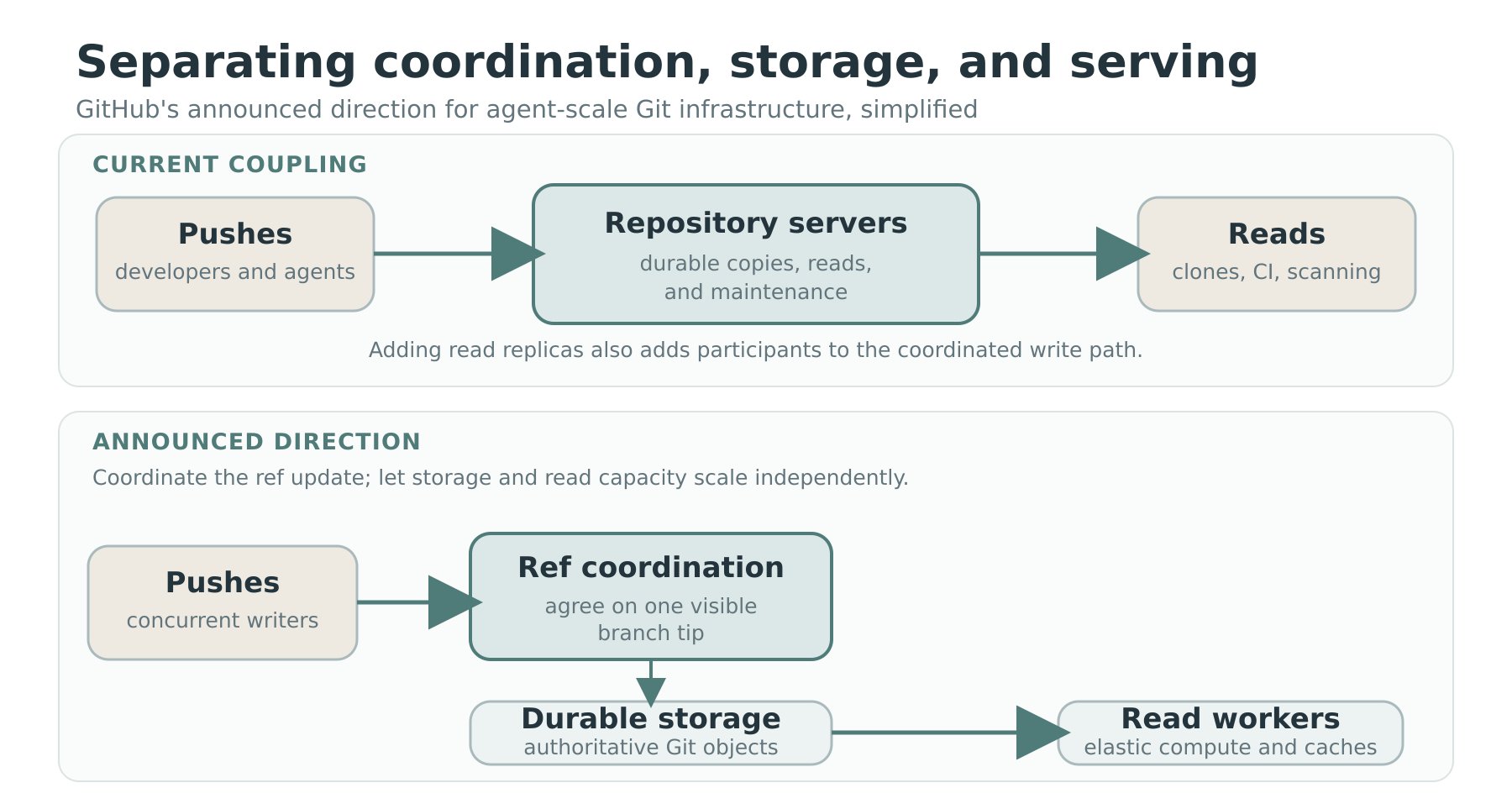
GitHub’s current Spokes architecture keeps complete repository copies on several file servers. Those replicas provide durability and spread read traffic, but every participating replica also adds work to a push. More copies can increase read capacity while making the coordinated write path slower.
A Git repository is primarily a collection of immutable objects plus mutable references, or refs, that identify visible branch and tag tips. The objects hold content and history; updating a ref makes a different commit the current branch tip. Pro Git explains these internals in its chapters on Git objects and references.
A quorum is the minimum set of replicas that must agree before a write is accepted. It protects consistency and durability, but coordination adds latency and becomes harder to scale when many writers converge on the same repository.
The architectural signal
GitHub’s proposed direction reduces the amount of work that must proceed in lockstep. The reference update remains coordinated because clients need one visible repository state. Storing Git objects, validating connectivity, scanning for secrets, and maintaining repository data can proceed separately or in parallel.
The second move is to separate durable storage from the compute that serves Git requests. GitHub says authoritative repository data will live in Azure Blob Storage, while lightweight workers cache data and scale with read demand. Losing a worker should then resemble losing a cache rather than losing both serving capacity and one authoritative repository copy.
This design depends on the storage layer providing the required durability and replication properties. Microsoft’s Azure Blob Storage reliability documentation describes the available redundancy models; the configuration and end-to-end guarantees still remain the service operator’s responsibility.
What the announcement does not prove
GitHub reports that internal benchmarks have reached up to 35 times higher write throughput. That is encouraging, but it is not a universal performance promise: the post does not publish the complete benchmark workload, migration state, cost profile, or behavior across every repository pattern.
The harder questions will appear during deployment. GitHub must preserve branch protection, auditability, reference consistency, and predictable recovery while changing the storage foundation beneath active repositories. Separating storage and compute can remove one scaling limit, but it also makes cache behavior, storage latency, background maintenance, and failure isolation more important.
The sparse signal
Coding agents are becoming a capacity-planning concern for systems that were designed around human interaction rates. Their effect is not limited to how quickly code is written: they alter the concurrency, write frequency, branch count, and automation fan-out that surrounding platforms must absorb.
GitHub’s redesign is one early example of that shift becoming visible in production infrastructure. As agent fleets grow, other developer platforms may face the same question: which operations truly require coordination, and which can be separated so that storage, compute, and maintenance scale independently?