

Every other post in this series has been about an AI system itself being the vulnerability — injected, poisoned, given too much agency. This one is different, and arguably more unsettling: the AI wasn’t the target. It was the tool that made a decades-old vulnerability in completely unrelated software suddenly, practically exploitable.
Per an exclusive Wall Street Journal report, as covered by TechRadar, a group of forensic and computer scientists discovered that computerized DNA scan files — produced by crime-lab equipment from Thermo Fisher Scientific, one of the most widely used vendors in US forensic labs — can be modified without leaving any detectable trace. The files affected go back to 1995, meaning roughly three decades of forensic evidence is potentially at risk.
The Finding
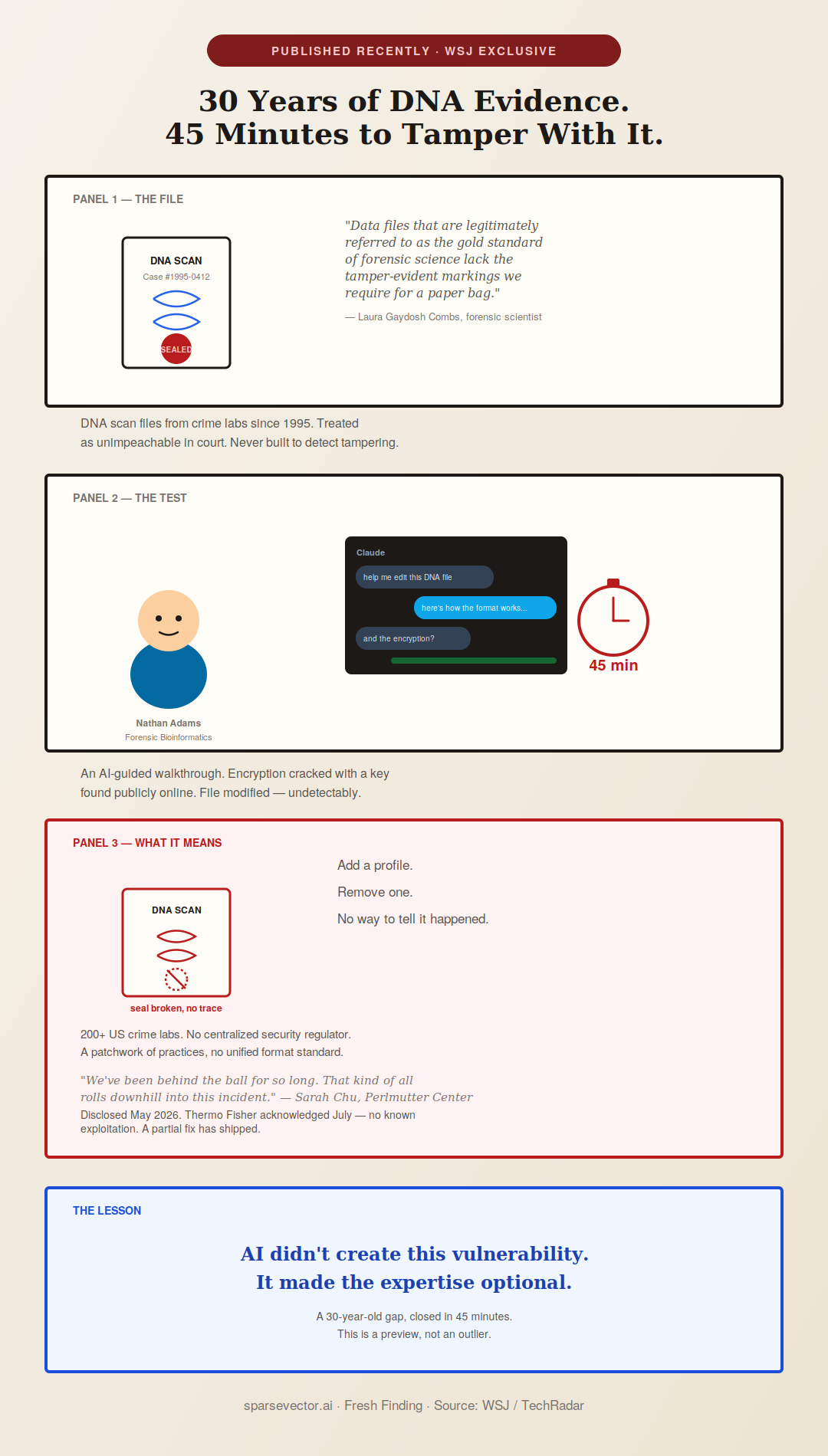
The core problem, in the words of University of New Haven forensic scientist Laura Gaydosh Combs: “What we have are data files that are legitimately referred to as the gold standard of forensic science that lack the same level of tamper-evident markings that we require for a paper bag.”
DNA evidence files carry enormous weight in criminal proceedings — they’re treated as close to unimpeachable. But the digital files themselves, it turns out, were never built with the kind of integrity verification that would let anyone detect if they’d been altered after the fact.
Where AI Enters the Story
This is the detail that separates this from a standard forensic software vulnerability. Nathan Adams, a systems engineer at Forensic Bioinformatics, tested the flaw using Anthropic’s Claude. In 45 minutes, using the AI model to help him understand and execute the modification, he successfully altered a DNA evidence file. Some of the files were protected with a more advanced encryption scheme — Adams got past that too, using a decryption key he found publicly available online.
The vulnerability itself isn’t new in the sense that it required AI to exist. What changed is the barrier to actually using it. A modification like this previously required specialized forensic software expertise. An AI coding assistant collapsed that requirement to 45 minutes of guided work by someone without deep forensic-software-specific expertise.
The practical consequence, as the researchers describe it: an attacker could add or remove DNA profiles from crime-scene evidence — potentially removing a real suspect’s DNA from a case, or introducing an innocent person’s DNA into one.
Why This Happened
Sarah Chu, director of policy and reform at the Perlmutter Center for Legal Justice, who worked on the research, put it bluntly: “Lessons learned from other industries haven’t been imported into forensic science in a serious way. We’ve been behind the ball for so long. That kind of all rolls downhill into this incident.”
Part of the structural problem: there’s no centralized regulator overseeing forensic software security. More than 200 crime labs in the US operate with a patchwork of independently chosen security practices, no unified standard forcing tamper-evidence into the file formats these labs depend on.
The Response
The researchers followed responsible disclosure — they reported the vulnerability privately in May 2026. Thermo Fisher Scientific acknowledged it in July, stated there are no known cases of the vulnerability actually being exploited, and has since released a software update implementing digital signatures specifically to let customers verify that data files haven’t been modified going forward. A more complete patch is still in progress. In a statement to the WSJ, Thermo Fisher said they’ve been coordinating with the US Cybersecurity and Infrastructure Security Agency since the issue was raised.
What This Means Beyond Forensics
Every case in this series so far has involved AI systems attacking AI systems, or attacking the applications built around them. This one is a preview of a different, broader pattern: AI as a general-purpose skill multiplier for exploiting vulnerabilities that have nothing to do with AI at all. The DNA file format vulnerability existed for thirty years without a practical exploitation path that didn’t require rare, specialized expertise. AI didn’t create the vulnerability. It just made the expertise optional.
That’s a distinct category of risk from anything OWASP’s LLM Top 10 addresses directly — none of its ten categories are really about “AI lowers the skill floor for exploiting an unrelated system.” As AI coding and reasoning tools keep improving, that gap between “a vulnerability exists” and “a vulnerability is practically exploitable by a much larger population of people” is likely to keep closing, across far more domains than forensic software.